


Table of Contents
Introduction
The fitness industry is undergoing its most significant transformation since the invention of the treadmill. Artificial Intelligence (AI) has moved beyond experimental wearables and is now a core component of how people train, how coaches instruct, and how gyms operate. From personalized workout generation to predictive injury prevention, AI is bridging the gap between expensive one-on-one personal training and generic workout plans. However, as this technology becomes ubiquitous, a critical question arises: Is AI a genuine tool for empowerment, or does it foster unhealthy comparison?
AI in the Fitness Industry
AI in fitness refers to the use of machine learning algorithms, computer vision, and data analytics to mimic human intelligence in exercise settings. Unlike traditional fitness tech (like a pedometer), AI learns from user data to adapt in real-time. For example, if a user struggles with a squat, an AI app can detect form degradation and modify the rep range or tempo instantly. This creates a dynamic feedback loop that was previously impossible without a human trainer watching every rep.
Ways AI Can Benefit Your Gym
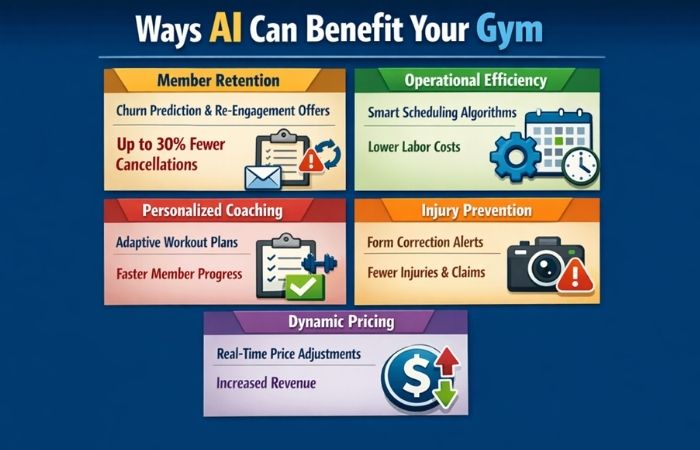
| Benefit Category | Specific Application | Impact on Gym |
|---|---|---|
| Member Retention | AI predicts churn risk by analyzing visit frequency and sends automated re-engagement offers. | Reduces membership cancellations by up to 30%. |
| Operational Efficiency | Smart scheduling algorithms optimize class times and staff shifts based on historical attendance data. | Lowers labor costs and maximizes room usage. |
| Personalized Coaching | AI analyzes workout history to suggest progressive overload (weight/reps) for each member. | Increases member progress speed and satisfaction. |
| Injury Prevention | Computer vision on cameras flags unsafe lifting form before an injury occurs. | Reduces liability claims and down-time injuries. |
| Dynamic Pricing | Algorithms adjust membership and class prices based on real-time demand and seasonality. | Boosts revenue during peak hours and fills off-peak slots. |
AI in the Fitness Industry: Helpful Tool or Comparison Trap?
| Aspect | Helpful Tool (The Upside) | Comparison Trap (The Downside) |
|---|---|---|
| Progress Tracking | AI anonymizes your data to show your strength gains over 12 weeks, ignoring others. | Leaderboards based on AI-generated “performance scores” can demotivate beginners. |
| Form Correction | Computer vision gives private, shame-free corrections without a trainer watching. | Comparing your AI “form score” to a pro athlete’s benchmark creates unrealistic standards. |
| Workout Generation | AI adapts to your injuries and fatigue levels for sustainable training. | Seeing AI suggest lower weights than a friend’s output triggers ego lifting and injury. |
| Body Composition | AI analyzes scan photos to show subtle positive changes the naked eye misses. | Frequent AI scans can exacerbate body dysmorphia and over-training. |
| Social Features | AI matches you with virtual workout partners of similar ability for accountability. | “Ranking” features turn fitness into a performative social media contest. |
Verdict: AI is a tool. When configured to focus on self-improvement metrics (PRs, consistency, recovery), it is helpful. When configured to focus on social ranking (total volume, calories burned leaderboards), it becomes a trap.
AI in Fitness: How AI is Transforming the Industry
| Area of Transformation | Traditional Method | AI-Powered Method |
|---|---|---|
| Program Design | Static 4-week PDF plan. | Dynamic daily plan adjusting based on sleep, HRV, and soreness. |
| Nutrition Coaching | Manual food diary reviewed weekly. | Photo recognition calorie/macro counting in 3 seconds. |
| Member Check-ins | Front desk scans a barcode. | Facial recognition + gait analysis identifies you and auto-logs workout. |
| Equipment Usage | Machines sit empty or overcrowded. | Smart mirrors and weights adjust resistance based on your real-time strength curve. |
| Recovery Advice | Generic “rest for 48 hours” rule. | AI predicts exact recovery timeline based on muscle oxygen saturation and inflammation markers. |
AI Fitness Apps
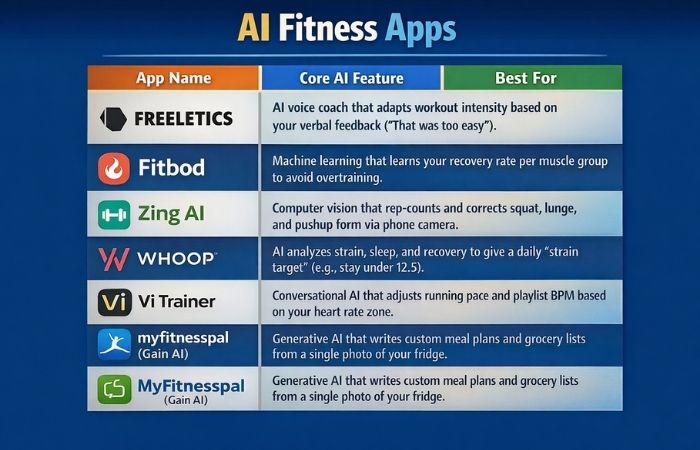
| App Name | Core AI Feature | Best For |
|---|---|---|
| Freeletics | AI voice coach that adapts workout intensity based on your verbal feedback (“That was too easy”). | Bodyweight training at home. |
| Fitbod | Machine learning that learns your recovery rate per muscle group to avoid overtraining. | Weightlifting and gym goers. |
| Zing AI | Computer vision that rep-counts and corrects squat, lunge, and pushup form via phone camera. | Form perfectionists. |
| Whoop | AI analyzes strain, sleep, and recovery to give a daily “strain target” (e.g., stay under 12.5). | Athletes focused on recovery. |
| Vi Trainer | Conversational AI that adjusts running pace and playlist BPM based on your heart rate zone. | Runners and cyclists. |
| MyFitnessPal (Gain AI) | Generative AI that writes custom meal plans and grocery lists from a single photo of your fridge. | Nutrition-focused users. |
AI in Fitness Industry: Training, Coaching & Gym Operations
| Domain | AI Application | Real-World Example |
|---|---|---|
| Personal Training | AI creates hyper-personalized monthly macrocycles (periodization) that no human coach has time to write. | Future.co – AI plans with human coach oversight. |
| Group Coaching | AI monitors heart rate of all class members and tells the coach who is slacking or redlining. | Polar Club – displays class effort on a big screen. |
| Gym Operations | Predictive maintenance alerts for treadmills before the belt slips or motor fails. | EGYM – smart equipment self-diagnoses issues. |
| Sales & Retention | AI lead scoring tells front desk exactly which trial member is most likely to buy (based on app usage). | Glofox – AI predicts conversion probability. |
| Cleanliness & Safety | AI cameras count occupancy and alert staff when wipes need refilling or machines need sanitizing. | GymIntel – computer vision for hygiene compliance. |
How AI Is Transforming Fitness Apps
The evolution of fitness apps from simple logbooks to intelligent coaches is driven by three key AI breakthroughs:
- Computer Vision (CV): Previously, apps only tracked what you typed. Now, using your phone’s camera, CV apps like Freeletics and Zing watch you exercise. They count reps, measure range of motion, and detect asymmetry (e.g., dropping one shoulder during a pushup). This turns any living room into a smart gym.
- Generative AI for Workouts: Older apps used static “if-then” logic (e.g., if you click “easy,” show workout A). Modern apps use large language models to generate completely novel workouts. You can type “I have 15 minutes, a kettlebell, and lower back pain” and the app generates a unique, safe routine instantly.
- Federated Learning for Privacy: The biggest transformation is happening in data privacy. Instead of sending your heart rate and sleep data to a central server, new apps (like Apple Fitness+ ) process AI models locally on your phone. The AI learns from you without exposing you, allowing for hyper-personalization without risking health data leaks.
Ultimately, AI has transformed fitness apps from passive diaries into active, reactive coaches that see, hear, and adapt to you.
Conclusion
Artificial Intelligence is not a passing fad in the fitness industry; it is the new infrastructure. For gym owners, AI offers unprecedented operational efficiency and retention power. For individuals, it democratizes access to personalized coaching that was once reserved for professional athletes.
However, the industry must tread carefully. The same algorithms that motivate a user to hit a new deadlift PR can push another into overtraining or body dysmorphia if comparison metrics are prioritized over health metrics. The future of fitness is not human versus machine, but human guided by machine—provided the machine prioritizes longevity, safety, and personal progress over vanity and competition.
FAQs
Q1: Is AI personal training cheaper than human training?
Yes. AI apps typically cost $10–$30/month, compared to $60–$150/session for human trainers. However, hybrid models (AI + occasional human check-ins) are emerging as the best value.
Q2: Can AI actually correct my form in real-time?
Yes, using your smartphone camera. Apps like Zing and Freeletics can detect poor squat depth, rounded backs, and uneven shoulders. However, they cannot physically spot you like a human can.
Q3: Will AI replace gym personal trainers?
No, but it will replace bad trainers. Great trainers will use AI to handle program design and data analysis, freeing them to focus on motivation, accountability, and hands-on form correction.
Q4: Do AI fitness apps sell my health data?
It depends on the app. Read the privacy policy. Many free apps sell anonymized data. Premium apps (Whoop, Fitbod) typically do not. Newer “on-device” AI apps offer the best privacy.
Q5: How accurate is AI calorie burn tracking?
More accurate than step counters, but less accurate than lab equipment. AI that uses heart rate + accelerometer + user metrics (height, weight, age) is roughly 80-90% accurate for steady-state cardio, but less accurate for strength training.
Q6: Can AI help with injury rehabilitation?
Yes, but only under a doctor’s supervision. AI can track range of motion improvement and flag compensatory movements. However, it cannot diagnose injuries. Always consult a physical therapist first.