


Table of Contents
Introduction
Running is one of the most accessible and effective forms of cardiovascular exercise. Whether your goal is to improve general fitness, lose weight, build endurance for a marathon, or simply clear your mind, starting with the right knowledge is key. Many beginners make the mistake of doing too much, too fast, which leads to injury or burnout. This guide provides essential tips for beginners, weight loss, long-distance running, breathing techniques, gear recommendations, and inspiration from the world’s best.
8 Tips For New Runners
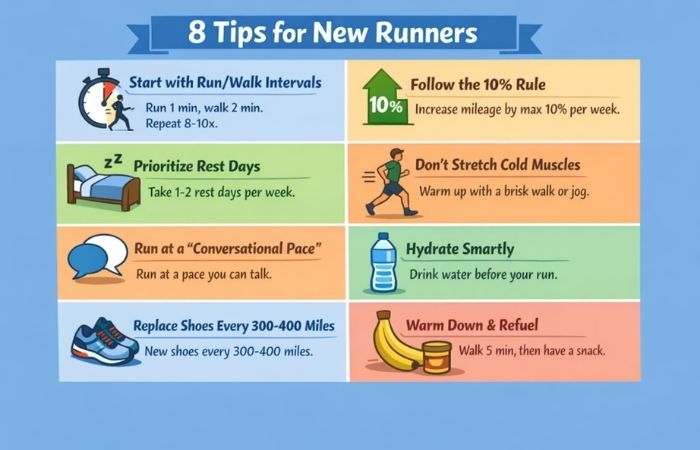
| Tip | Description |
|---|---|
| 1. Start with Run/Walk Intervals | Run for 1 minute, walk for 2. Repeat 8-10 times. Gradually increase running time. This builds endurance safely. |
| 2. Follow the 10% Rule | Never increase your weekly mileage by more than 10% from the previous week to avoid stress fractures and shin splints. |
| 3. Prioritize Rest Days | Take at least 1-2 full rest days per week. Your muscles repair and get stronger during rest, not during the run. |
| 4. Don’t Stretch Cold Muscles | Do a 5-minute brisk walk or light jog first. Save static stretches (touching toes) for after your run. |
| 5. Run at a “Conversational Pace” | You should be able to speak in short sentences. If you’re gasping for air, slow down. |
| 6. Hydrate Smartly | Drink 16-20 oz of water 1-2 hours before running. For runs under 60 minutes, water is enough. |
| 7. Replace Shoes Every 300-400 Miles | Worn-out shoes lose cushioning and change your gait, leading to knee/hip pain. Track your mileage. |
| 8. Warm Down & Refuel | Walk 5 minutes after running, then eat a snack with carbs and protein (e.g., banana + peanut butter) within 30 minutes. |
8 Tips For New Runners Beginners
| Tip | Description |
|---|---|
| 1. Get a Proper Gate Analysis | Visit a local running store. They will check if you overpronate (ankles roll in) or supinate (roll out) to recommend the right shoe. |
| 2. Dress for 20°F Warmer | Dress as if the temperature is 20°F (10°C) hotter than it is. You will heat up quickly. |
| 3. Use a “Couch to 5K” App | Apps like C25K structure your runs 3x/week for 9 weeks. Proven to take non-runners to 30 minutes of continuous running. |
| 4. Land Mid-Foot | Avoid heel-striking with your foot way out in front. Your foot should land directly under your body. |
| 5. Ignore Pace, Focus on Time | For your first 4 weeks, do not track pace. Only track minutes spent running. Pace doesn’t matter yet. |
| 6. Run on Soft Surfaces | Dirt trails, grass, or a track reduce impact on joints vs. concrete sidewalks. Save asphalt for race day. |
| 7. Expect Side Stitches | They are common. To relieve: exhale forcefully when the foot opposite the pain strikes the ground. |
| 8. Find a Buddy or Group | Having a commitment to meet someone increases consistency by 80%. Check local running clubs (often free). |
Running Tips For Beginners To Lose Weight
| Tip | Description |
|---|---|
| 1. Run in the Morning (Fasted?) | Running on an empty stomach may increase fat oxidation, but if you feel dizzy, eat a small banana. Morning runs also boost metabolism for hours. |
| 2. Add High-Intensity Intervals | Once weekly: 30 sec sprint / 30 sec walk x 10. HIIT burns more calories in less time and elevates afterburn (EPOC). |
| 3. Don’t Eat Back All Calories | A 3-mile run burns ~300 calories. That’s one granola bar. Many overestimate and gain weight. Log food. |
| 4. Run Longer, Not Faster | Fat burning is maximized during longer, slower runs (45+ minutes) at 60-70% of max heart rate. |
| 5. Strength Train 2x/Week | Muscle burns more calories at rest than fat. Add squats, lunges, and push-ups on non-run days. |
| 6. Run on Inclines | Treadmill incline 3-5% or hill repeats burn 30-40% more calories per minute than flat running. |
| 7. Stay Hydrated with Water Only | Sports drinks have sugar calories. For runs under 90 min, skip them. Drink water. |
| 8. Track Non-Scale Victories | Looser fit of clothes, better sleep, and lower resting heart rate indicate progress even if the scale stalls. |
Running Tips For Long Distance
| Tip | Description |
|---|---|
| 1. Build a Base First | Spend 6-8 weeks running 15-20 miles/week at easy pace before starting any half/full marathon plan. |
| 2. Practice Fueling | For runs >90 min: consume 30-60g carbs per hour (gels, chews, dried fruit). Never try a new gel on race day. |
| 3. Long Run at “Easy” Pace | Your weekly long run should be 90 sec to 120 sec per mile slower than your 5K pace. It builds endurance, not speed. |
| 4. Taper Before Race Day | Reduce mileage by 40-60% in the final 2-3 weeks before a marathon to let muscles fully repair and supercompensate. |
| 5. Practice Your Hydration Strategy | Drink 5-10 oz every 20-30 minutes. Plan where water stations are or carry a bottle/hydration vest. |
| 6. Run on Similar Terrain | If your race is hilly, train hills. If it’s a trail, train trails. Specificity is crucial for long distance. |
| 7. Use Body Glide or Vaseline | Apply to inner thighs, armpits, and nipples to prevent chafing over hours of repetitive motion. |
| 8. Negative Splits Strategy | Start slower than goal pace, finish faster. Example: If aiming for 4-hour marathon, run first half in 2:02, second in 1:58. |
Running Tips For Beginners Breathing
- Belly Breathing (Diaphragmatic): Place hand on stomach. Inhale so your belly pushes hand out (not chest rising). This brings in 40% more oxygen.
- Rhythmic Pattern: Use a 3:2 ratio (inhale for 3 steps, exhale for 2 steps). This alternates which foot lands during exhalation, reducing side stitches.
- Inhale Through Nose & Mouth: Nose-only breathing restricts oxygen. Inhale through nose and mouth simultaneously for maximum air intake.
- Exhale Forcefully: Don’t just let air drift out. Push it out with your diaphragm to clear CO2 and trigger the next inhale.
- Match Breathing to Effort: Easy run = 3:3 pattern (6 steps total). Hard run = 2:1 or 2:2 pattern. Faster breathing is fine, but keep it controlled.
- Check Your Posture: Slumped shoulders compress lungs. Run tall, chest open, chin level. Imagine a string pulling the top of your head up.
- If You Gasp: You are running too fast. Slow down or walk until you can speak full sentences. Gasping is anaerobic, not sustainable.
- Practice Off the Run: Lie on your back with a book on your belly. Breathe so the book rises and falls. Do this 5 min daily to train the diaphragm.
Best Shoes For Running And Where To Buy , Price
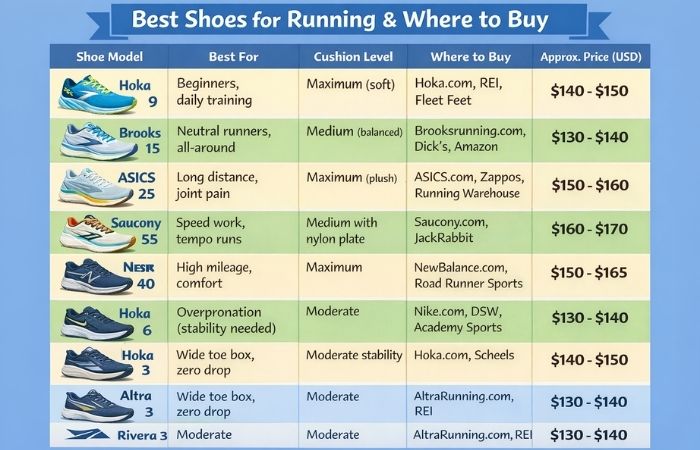
| Shoe Model | Best For | Cushion Level | Where to Buy | Approx. Price (USD) |
|---|---|---|---|---|
| Hoka Clifton 9 | Beginners, daily training | Maximum (soft) | Hoka.com, REI, Fleet Feet | $140 – $150 |
| Brooks Ghost 15 | Neutral runners, all-around | Medium (balanced) | Brooksrunning.com, Dick’s, Amazon | $130 – $140 |
| ASICS Gel-Nimbus 25 | Long distance, joint pain | Maximum (plush) | ASICS.com, Zappos, Running Warehouse | $150 – $160 |
| Saucony Endorphin Speed 3 | Speed work, tempo runs | Medium with nylon plate | Saucony.com, JackRabbit | $160 – $170 |
| New Balance Fresh Foam 1080v13 | High mileage, comfort | Maximum | NewBalance.com, Road Runner Sports | $150 – $165 |
| Nike Air Zoom Pegasus 40 | Versatile, durable everyday | Moderate | Nike.com, DSW, Academy Sports | $130 – $140 |
| Hoka Arahi 6 | Overpronation (stability needed) | Moderate stability | Hoka.com, Scheels | $140 – $150 |
| Altra Rivera 3 | Wide toe box, zero drop | Moderate | AltraRunning.com, REI | $130 – $140 |
Note: Prices are MSRP. Sales often available on prior-year models. Always try shoes on in-person at a running store for gait analysis.
World Top And Best Runners
| Runner | Country | Specialty | Best Achievement | Notable Time |
|---|---|---|---|---|
| Eliud Kipchoge | Kenya | Marathon | 2x Olympic gold, 1:59:40 (sub-2 hour, unofficial) | 2:01:09 (world record) |
| Usain Bolt | Jamaica | Sprint (100m/200m) | 8x Olympic gold, world records | 9.58 sec (100m), 19.19 (200m) |
| Faith Kipyegon | Kenya | 1500m / Mile | 2x Olympic gold, world records in 1500m, mile, 5000m | 3:49.11 (1500m WR) |
| Jakob Ingebrigtsen | Norway | 1500m / 5000m | Olympic gold (1500m), European champion | 3:43.73 (mile indoors) |
| Sifan Hassan | Netherlands | 1500m to marathon | Olympic medals in 1500m, 5000m, 10,000m, won London Marathon | 2:13:44 (marathon) |
| Kenenisa Bekele | Ethiopia | 5000m / 10,000m | 3x Olympic gold, former world records | 12:37.35 (5000m WR), 26:17.53 (10,000m WR) |
| Tirunesh Dibaba | Ethiopia | 5000m / 10,000m | 3x Olympic gold, 5x world champ | 14:11.15 (5000m) |
| Joshua Cheptegei | Uganda | 5000m / 10,000m | Olympic gold, world records | 26:11.00 (10,000m WR) |
Conclusion
Starting your running journey is a rewarding process that requires patience, consistency, and the right preparation. For beginners, remember to start slow, use run/walk intervals, and invest in proper shoes. If weight loss is your goal, combine longer runs with strength training and mindful nutrition. For long-distance aspirations, focus on building a base, practicing fuel, and respecting the taper. Proper breathing technique—belly breathing and rhythmic patterns—will transform your comfort level. Finally, draw inspiration from legends like Kipchoge and Bolt, but remember that your only competition is yesterday’s you. Lace up, go easy, and enjoy the run.
FAQS
Q1: How many times a week should a beginner run?
A: 3 times per week (e.g., Monday, Wednesday, Friday). This allows rest days in between for recovery.
Q2: Is it OK to run every day?
A: Not for beginners. Your bones, joints, and connective tissues need adaptation time. Run every other day for the first 3 months.
Q3: How long will it take to see weight loss results from running?
A: With consistent 3-4 runs/week plus a calorie deficit, expect noticeable changes in 4-6 weeks. The scale may stall but inches often shrink first.
Q4: What should I eat right before a run?
A: A small, easily digestible snack 30-60 min prior: half a banana, a rice cake with jam, or 1-2 dates. Avoid high-fiber or fatty foods.
Q5: Why do my shins hurt when I run?
A: Likely “shin splints” (medial tibial stress syndrome). Causes: too much too soon, worn shoes, or heel-striking. Rest, ice, and strengthen calf muscles.
Q6: Can I run if I have knee pain?
A: It depends. If pain is sharp or swelling occurs, stop. If mild, try running on soft surfaces, shortening your stride, and strengthening glutes/hips. See a physical therapist.
Q7: How do I breathe when I get a side stitch?
A: Slow down to a walk. Exhale forcefully when the foot opposite the pain hits the ground. Press two fingers into the painful spot while exhaling.
Q8: What is the best time of day to run?
A: The best time is whenever you will actually do it consistently. Morning: cooler, fewer excuses. Afternoon: body is warmed up, less injury risk. Evening: good stress relief.
Q9: How do I know when to replace my running shoes?
A: Every 300-500 miles. Signs: tread worn smooth, midsole feels hard (no squish), or you develop new aches (knee, shin, hip) that disappear with new shoes.
Q10: Should I run through soreness?
A: General muscle soreness (DOMS) is fine to run through but do an easy, short run. Sharp or localized pain (e.g., specific spot on knee) – do NOT run.